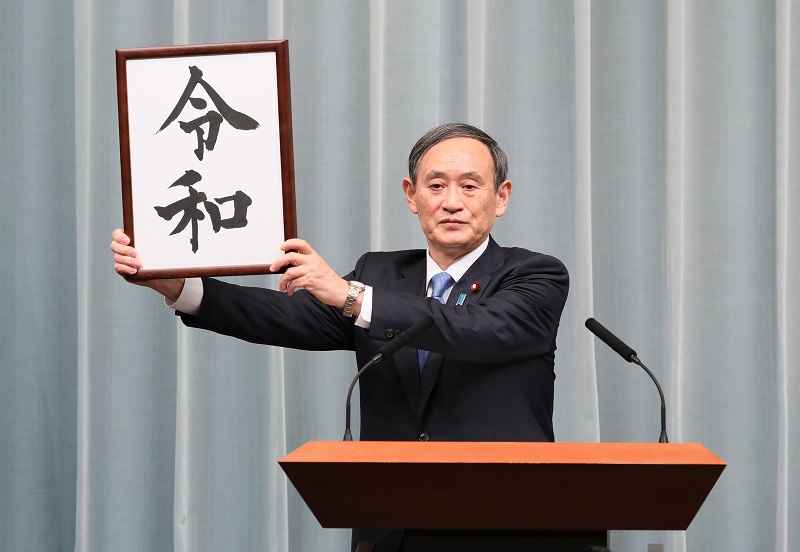
- What is "元号 (Gengo)"? Japanese era name, used to describe the year.
- What is the origin of using "元号 (Gengo)"? Japanese Diplomats in ancient days introduced this culture of "counting the era" after visiting China.
- What is the "元号 (Gengo)" now? It is now "令和 (Reiwa)", the era which started since May 2019.
- When does this "元号 (Gengo)" change? It changes each time a new emperor reigns, and continues as Year 1, 2, 3 ... and onwards until the emperor changes.
- Who decides the "元号 (Gengo)" name of each era? The Japanese cabinet.
- How is this "元号 (Gengo)" used? For Japanese governmental related documents, calendars, and especially in New Year greeting cards.
- What is the meaning of "令和 (Reiwa)"? "Cultures are born and grow, when people beautifully bring their hearts
together."
During your visit in Japan, you may sometimes encounter words such as "令和 (Reiwa)" or "平成 (Heisei)". These are words which describe the era or "元号
(Gengo)", and is used in a similar way like the western A.D. year system. The "元号 (Gengo)" is changed each time a new
emperor reigns.
The current "元号 (Gengo)" is "令和 (Reiwa)" which started from May 1st 2019, at the same time Prince Naruhito of the royal family had been appointed as the new emperor of Japan. 2019 was the 1st year of "令和 (Reiwa)", so if you are to describe the year 2023, you would say "令和5年 (Year 5 of Reiwa) ".
The "元号 (Gengo)" is used often in official governmental documents, so when you see some posters made by the Japanese government, you will often see "令和5年" instead of "2023". For example, when the Japanese have to submit official documents to the city hall, upon moving, marriage, tax payments, etc., the citizens always will have to write the year in "元号 (Gengo)" style. The "元号 (Gengo)" is also used very frequently upon celebrating of the new year, especially in greeting cards, also called "年賀状 (Nengajo)". If you are to send a New Year's greeting card to your Japanese friend, you will sound very familiar to Japanese cultures by writing the latest "元号 (Gengo)" of the new year!
The current "元号 (Gengo)" is "令和 (Reiwa)" which started from May 1st 2019, at the same time Prince Naruhito of the royal family had been appointed as the new emperor of Japan. 2019 was the 1st year of "令和 (Reiwa)", so if you are to describe the year 2023, you would say "令和5年 (Year 5 of Reiwa) ".
The "元号 (Gengo)" is used often in official governmental documents, so when you see some posters made by the Japanese government, you will often see "令和5年" instead of "2023". For example, when the Japanese have to submit official documents to the city hall, upon moving, marriage, tax payments, etc., the citizens always will have to write the year in "元号 (Gengo)" style. The "元号 (Gengo)" is also used very frequently upon celebrating of the new year, especially in greeting cards, also called "年賀状 (Nengajo)". If you are to send a New Year's greeting card to your Japanese friend, you will sound very familiar to Japanese cultures by writing the latest "元号 (Gengo)" of the new year!


